- Leading Disruption
- Posts
- Your AI Readiness Assessment May Be Holding You Back
Your AI Readiness Assessment May Be Holding You Back

Charlene Li
March 10, 2026
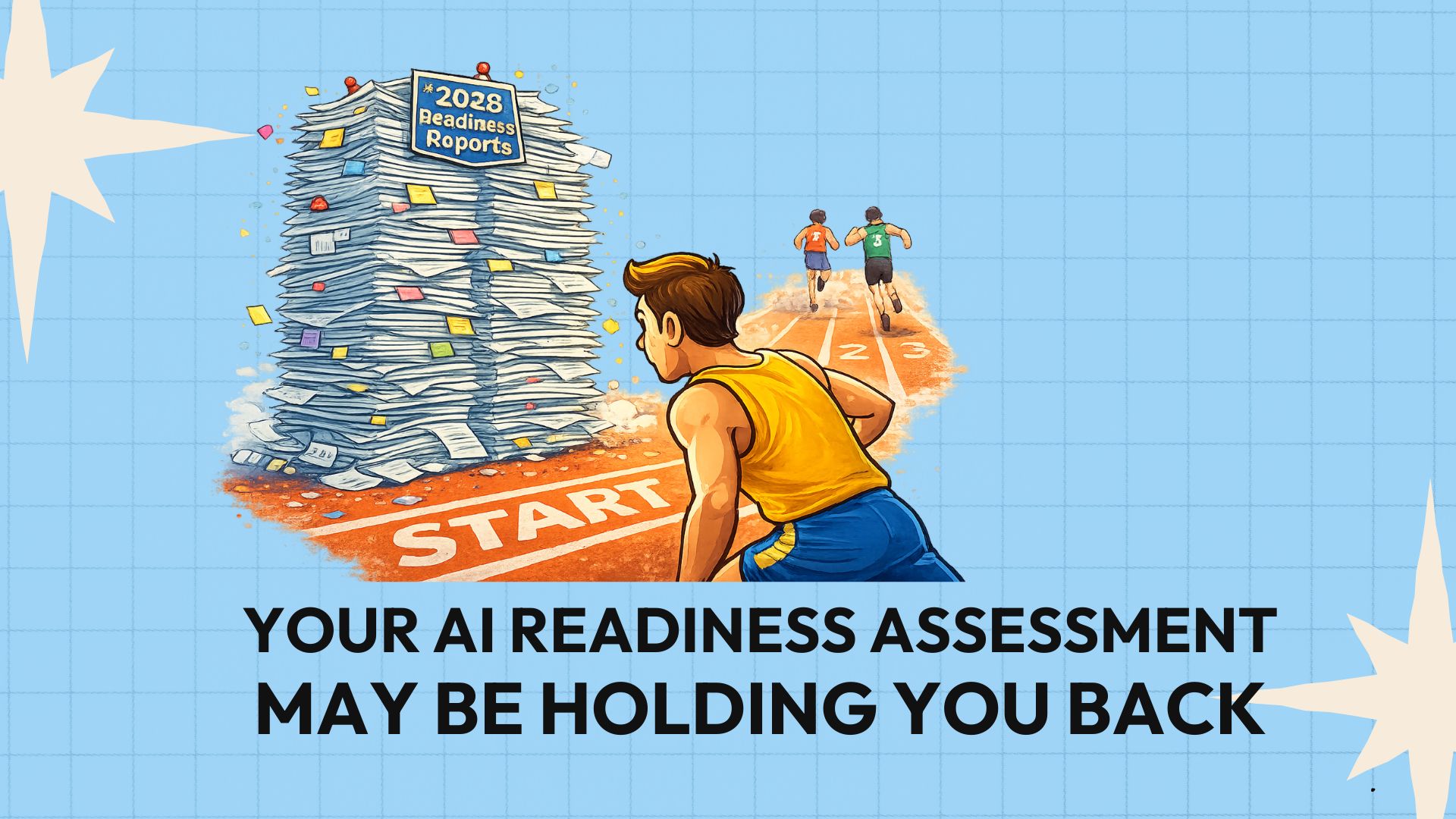
Have you ever been told to complete an AI readiness assessment before moving forward? Or have you been the one making that recommendation to others?
I have a confession to make.
When my co-author, Dr. Katia Walsh, and I were writing Winning with AI, we built an entire AI readiness assessment. We spent weeks on it. It had beautiful weights, comprehensive assessment questions, a rigorous scoring system ... and then we threw it all out.
Not because it wasn't good. Because it was solving the wrong problem.
The Readiness Trap
Here's a scene I see playing out constantly: A leadership team decides to get serious about AI. Someone raises their hand (usually a consultant, sometimes an internal champion) and says, "First, we need to know where we stand. Let's do a readiness assessment."
So they survey people. They audit data. They score the culture. They benchmark against competitors. Weeks go by. Sometimes months.
Then the results arrive. Here's the thing nobody says out loud: the report almost always tells you that you're not ready.
Your data has quality issues. Your culture resists change. Your governance moves too slowly. Your talent needs development.
That's the nature of readiness assessments; they're designed to surface gaps, and they will always find them.
So, you get a score, maybe a 62 out of 100. Great. Now what? Do you wait until you score an 80 before you get started? You've just invested weeks or months in this process and haven't made one meaningful decision about how AI will actually create value for your organization.
The problem we found is readiness assessments don't eliminate risk. They don't help you figure out what key decisions need to be made. They just delay progress and make your uncertainty look more official.
The Real Risk Is Standing Still
The hard truth is that waiting until you're "ready" is itself a competitive risk.
While you're assessing, your competitors are shipping.
The companies winning with AI aren't the ones preparing the longest or preparing the best. They're the ones who start moving, make decisions, and learn as they go. They’re iterating and filling the gaps along the way.
Readiness is a myth. You'll never feel completely ready. And that's not because preparation doesn't matter, it's because the sequence is backward.
Flip the Script
What Katia and I argue in the book, and what we've seen work in practice, is that the sequence should look like this:
Start with your business strategy. What are your top priorities? What problems are you trying to solve?
Identify how AI can support it. Not "we want to use AI," but "we want to reduce time to quote" or "we want to improve customer retention."
Then assess the gaps. But only for that specific application, for that specific business outcome, on that specific timeline.
Your business priorities won't wait for your AI readiness. If your plan requires expanding into new markets, improving customer retention, or cutting operational costs, those imperatives exist regardless of your AI maturity.
Instead of asking, "Are we ready for AI?" you should be asking, "What does AI need to deliver against what we've already committed to?"
A Targeted Gap Assessment Is a Different Animal
When you do the gap assessment after you've set your plan, it's a completely different situation. Instead of a broad, abstract audit that exists outside your strategic plan, you're asking something very specific:
What do we need in terms of people, data, tools, and governance to ship this particular AI application, for this particular business outcome, by this particular date?
Think of it like a pre-flight checklist. You don't cancel the trip because the checklist surfaces issues. You address what needs fixing so you can take off. The assessment shows you what to solve and when, so you can fly the route you've already planned.
Confronting the Objections
I hear pushback all the time. These are the objections I get most often:
"Our data is a mess." Data is always a mess. This is true in every organization, at every maturity level. The real question isn't whether your data has gaps; it's whether your data is blocking a specific initiative, or whether you're just uncomfortable with imperfection. More often than not, you can launch with what you have while improving what you'll need later.
"We need executive buy-in first." Your strategic priorities are the way to getting buy-in. When AI is framed around goals that executives have already endorsed, and not positioned as a separate technology initiative, you're having a resource conversation. Not a philosophical debate.
"We need a baseline to measure progress." The most revealing baseline emerges about two weeks into actual implementation. Doing the work exposes realities that no survey can capture.
The Emotional Truth
Let's be honest about what's really happening. For many leaders, readiness assessments function as a security blanket. There's comfort in the thought: If we haven't started, we can't fail.
With so much uncertainty swirling around AI, assessment activity feels productive. It generates deliverables. It fills calendars. But it postpones the harder work of making real choices about priorities, trade-offs, and commitments.
Here's what I want you to internalize: You will get things wrong. That's not a risk to be managed, it's the process itself. The organizations succeeding with AI are building the plane as they're flying it. And they're getting better faster than anyone still waiting on the runway.
📣 Your Turn
Have you found yourself caught in the assessment-analysis loop? What's held you back from just getting started?
Drop your experiences in the comments, I'd love to hear what's worked (and what hasn't).
What I Can't Stop Talking About
As Vikram Mahidhar says, "Speed is the new moat; you have to go fast." The companies winning with AI aren't waiting for perfect conditions.
In our book, “Winning with AI: The 90-Day Blueprint for Success“ Katia and I break down the mindset, skill set, tool set, and decision set you need to actually deliver on your AI initiatives. Understanding where your gaps are, once your strategy has been set, is the key to moving fast.
And the big day is almost here! Our book comes out on March 24th. If you want a practical, no-fluff guide to creating real value with AI, sign up for updates and early access at winningwithaibook.com. Pre-order links are coming soon.
My Upcoming Appearances/Travel
Mar 12: Private event, Oklahoma City, OK
Mar 25: Private event, Las Vegas, NV
Apr 16: Private event, Washington, DC
May 7: YPO Global Marketing Summit, Keynote, San Francisco, CA
May 19: Internal company meeting, Nashville, TN

If you found this note helpful, please forward and share it with someone who needs the inspiration today. If you were forwarded this, please consider subscribing.